


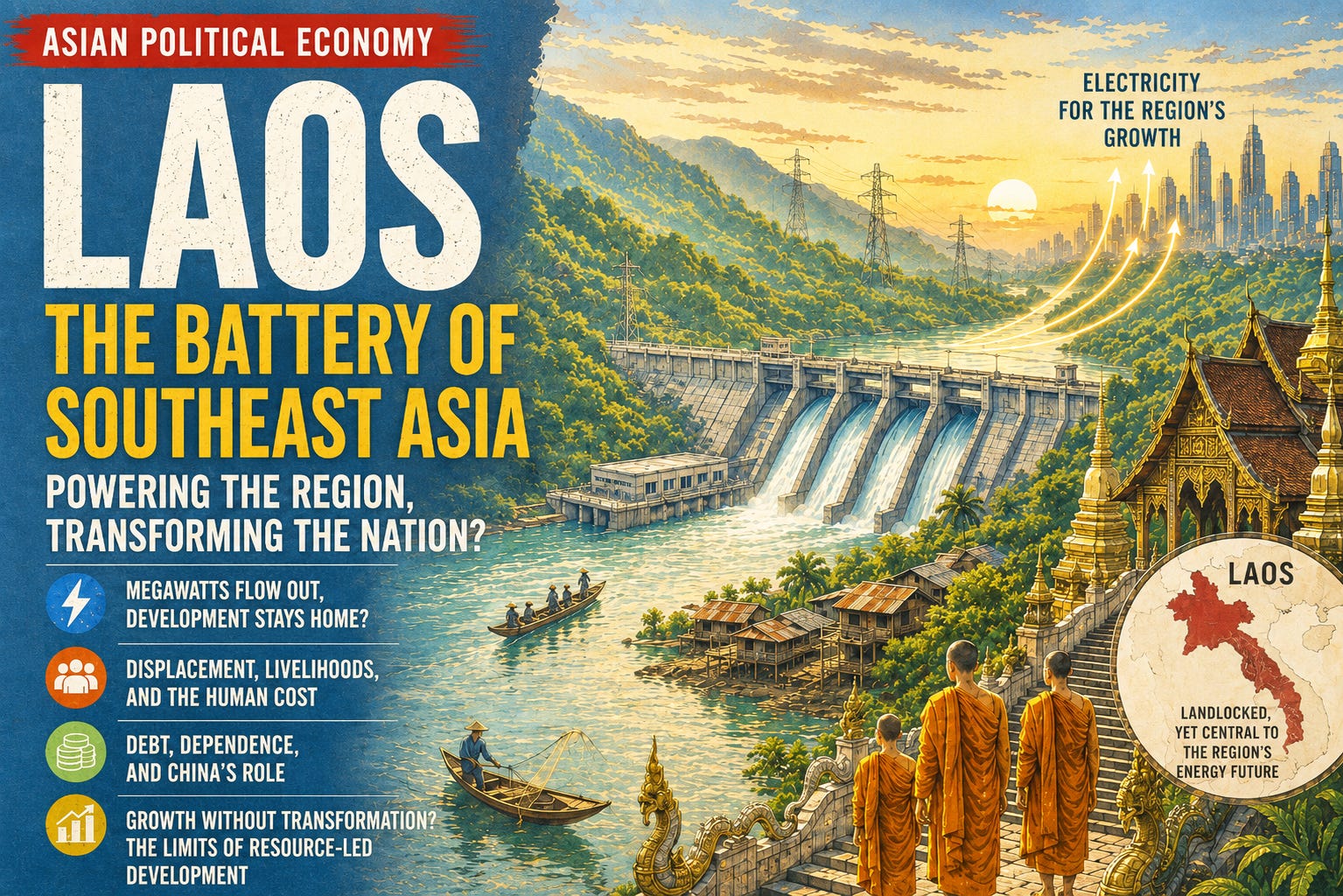
Few countries have wagered their future on a single development idea as boldly as Laos.
Over the past three decades, the small, landlocked country has attempted one of the most ambitious economic transformations in contemporary Asia. The idea appeared deceptively simple. Laos possessed abundant rivers flowing through mountainous terrain. Its neighbours possessed growing industries, expanding cities, and increasing demand for electricity. If these rivers could be harnessed through large-scale hydropower projects, Laos could export energy to the rest of the region. Geography itself could be transformed from a burden into an opportunity.
Successive governments embraced this vision enthusiastically. Laos would become the “Battery of Southeast Asia.” The slogan captured a powerful aspiration. Few countries in the world face as many structural constraints as Laos. With a population of fewer than eight million people, limited industrial capabilities, a relatively small domestic market, and no direct access to the sea, the country appeared poorly positioned to follow the export-oriented industrialization path associated with East Asia’s most celebrated development success stories.
Unlike South Korea, Taiwan, or even more recently Vietnam, Laos lacked the demographic scale, manufacturing base, and institutional capacities necessary to rapidly integrate into global manufacturing networks. Industrialization on the East Asian model appeared difficult, if not impossible.
Hydropower offered an alternative. Electricity exports promised foreign exchange earnings without requiring sophisticated technological capabilities. Dams would attract foreign investment. Revenues would finance infrastructure, public services, and modernization. Development could proceed without fundamental changes to the country’s political system. The ruling Lao People’s Revolutionary Party could preserve political stability while delivering economic growth.
For a time, the strategy appeared remarkably successful. Dams multiplied across the country. International investors arrived. Roads improved. Economic growth accelerated. Laos graduated from the category of the world’s poorest economies and began to present itself as an emerging player within mainland Southeast Asia. International institutions often portrayed hydropower as one of the country’s greatest comparative advantages.
Yet beneath this apparent success lies a more complicated story.
Despite decades of hydropower expansion, Laos remains one of Southeast Asia’s least industrialized economies. Much of the investment underpinning the sector originates abroad. Public debt has expanded dramatically. Local communities have borne significant social and environmental costs. The country’s economic future has become increasingly intertwined with decisions made in Bangkok, Beijing, Hanoi, and the boardrooms of foreign investors.
The Lao experience therefore raises a broader question extending far beyond the Mekong River. Can infrastructure generate development? More specifically, can the export of electricity produced through large-scale infrastructure projects provide the foundations for structural transformation? Or does it merely reorganize dependency in new forms?
These questions matter because Laos is not unique. Across the developing world, governments increasingly turn toward infrastructure as a solution to the challenge of development. Ports, railways, energy projects, industrial corridors, and special economic zones promise to unlock growth by connecting countries to regional and global markets. Infrastructure has become one of the defining development paradigms of the twenty-first century.
The assumption is straightforward. Build the infrastructure, attract the investment, and development will follow. The experience of Laos suggests that reality may be more complicated.
This essay argues that the Lao hydropower strategy should be understood not simply as an energy policy but as a particular model of integration into regional capitalism. The ambition to become the Battery of Southeast Asia has generated growth and transformed the country’s physical landscape. Yet it has also produced new forms of dependency rooted in foreign finance, uneven regional integration, and limited domestic productive transformation.
The issue is therefore not whether dams “work.” They clearly can generate electricity, revenues, and economic growth. The more difficult question is whether they can generate development.
To answer that question, we need to understand how a small socialist country emerging from decades of war came to place such extraordinary hopes in the power of its rivers.
I. A Country Looking for a Development Model
To understand why Laos embraced hydropower so enthusiastically, one must first appreciate the magnitude of the developmental challenge the country faced at the end of the twentieth century.
Modern Laos emerged from war among the poorest countries in the world. Decades of conflict had left deep scars on the country’s economy and society. During the broader Indochina wars, Laos became one of the most heavily bombed countries in history. Large areas of the countryside remained contaminated by unexploded ordnance. Infrastructure was limited. Educational attainment was low. The industrial base was extremely weak.
When the Lao People’s Revolutionary Party came to power in 1975, it inherited a country with few of the conditions commonly associated with successful industrialization. The new leadership initially pursued a socialist development strategy based on central planning and state ownership. As elsewhere in the socialist world, the state sought to direct economic activity through administrative mechanisms rather than markets. Yet Laos faced severe structural constraints. The domestic market was tiny. Human capital was limited. State capacity remained weak outside major urban centres. Dependence on foreign aid—particularly from the Soviet Union and Vietnam—became unavoidable.
By the mid-1980s, the limitations of this model had become increasingly apparent. The crisis confronting Laos was not unique. Across the socialist world, governments were struggling to reconcile ideological commitments with economic realities. In China, Deng Xiaoping had already initiated market-oriented reforms. Vietnam would launch Đổi Mới in 1986. Laos followed a similar path through the introduction of the New Economic Mechanism that same year.
The reforms represented a profound shift in economic thinking.
Price controls were gradually relaxed. Private enterprise was tolerated and eventually encouraged. Foreign investment was welcomed. State-owned enterprises were restructured. Market mechanisms increasingly replaced administrative allocation. Yet unlike the transitions occurring in Eastern Europe after the collapse of communism, political liberalization did not accompany economic reform. The Lao People’s Revolutionary Party maintained its monopoly over political power while pursuing selective market opening.
In principle, the objective resembled that of other socialist market economies: harness market forces to accelerate development without relinquishing political control. In practice, however, Laos confronted a very different set of circumstances from those facing either China or Vietnam.
China possessed an enormous domestic market, abundant labour, and coastal regions ideally positioned to attract export-oriented investment. Vietnam benefited from a large population, a stronger tradition of state administration, relatively high educational attainment, and proximity to East Asian production networks. By the 1990s, Vietnam was increasingly able to attract foreign manufacturers seeking low-cost production sites.
Laos lacked many of these advantages.
Its population was small and geographically dispersed. The country was landlocked, increasing transportation costs and reducing competitiveness in manufacturing. Domestic purchasing power remained limited. Infrastructure deficiencies made integration into global supply chains difficult. Even basic logistical challenges—from roads and border crossings to electricity provision—constrained industrial expansion.
The contrast with Vietnam is particularly revealing. During the same period that Laos was searching for a development strategy, Vietnam was beginning its ascent as a manufacturing economy. Foreign firms established factories producing garments, footwear, and eventually electronics. Industrial zones multiplied. Exports diversified. Millions of workers entered wage employment linked to global value chains.
Laos followed a different path. This divergence was not simply the result of better or worse policy choices. Geography mattered. History mattered. Scale mattered. Development strategies are always shaped by the opportunities and constraints confronting policymakers.
For Lao leaders, the question was therefore not whether to imitate South Korea or Taiwan. The question was what forms of development remained available to a small, landlocked economy with limited industrial capabilities operating within an increasingly globalized world economy.
Natural resources appeared to provide the answer. Timber exports expanded rapidly during the early reform period. Mining attracted growing attention. But it was hydropower that seemed to offer the greatest promise.
The logic was compelling. If Laos could not compete internationally by exporting manufactured goods, perhaps it could export something else. Unlike manufacturing, hydropower did not require millions of workers or sophisticated industrial ecosystems. Unlike high-technology industries, it did not depend upon extensive domestic research capabilities. Instead, it relied upon a resource the country possessed in abundance: rivers.
The Mekong River and its numerous tributaries descend through Laos’s mountainous terrain with considerable hydrological potential. Engineers and international development agencies had long recognized this possibility. What changed during the 1990s was the regional context that made exploitation commercially viable.
Thailand’s rapidly industrializing economy required ever-increasing quantities of electricity. Demand projections suggested persistent energy shortages. Regional economic integration deepened. Foreign investors became more willing to finance large infrastructure projects in developing economies.
Suddenly, Laos’s rivers appeared not as geographical features but as economic assets. The transformation was profound. Development came to be imagined less through the creation of factories and more through the construction of dams. Rivers became engines of growth. Water became a source of export revenue. Infrastructure itself became the developmental strategy.
For policymakers in Vientiane, this vision possessed undeniable appeal. Hydropower promised growth without mass industrialization, export earnings without extensive manufacturing capabilities, and modernization without political liberalization.
The Battery of Southeast Asia was born not merely from ambition, but from necessity. Yet the very conditions that made the strategy attractive also contained the seeds of its future contradictions. Because Laos lacked the domestic capital, technical expertise, and financial resources necessary to develop the sector independently, realizing the hydropower dream would require extensive reliance on external actors.
The country’s path toward energy-led development would therefore become inseparable from its integration into regional capitalism. The rivers of Laos could generate electricity. But who would own the dams, finance their construction, purchase the power, and ultimately capture the benefits remained very different questions.
II. Selling Rivers: How the Mekong Became an Energy Frontier
If the Battery of Southeast Asia was born from Laos’s search for a viable development strategy, it could only become reality because of transformations occurring beyond the country’s borders. The story of Lao hydropower is therefore not simply a national story. It is a regional one.
Dams are often presented as technical responses to domestic energy needs. Governments require electricity. Engineers identify suitable sites. Investors provide financing. Infrastructure follows. Yet the rapid expansion of hydropower in Laos cannot be understood through such a narrow lens. The country’s dams were not built primarily to satisfy domestic consumption. They were built to feed the growing energy demands of neighbouring economies.
The most important of these was Thailand.
During the final decades of the twentieth century, Thailand experienced one of the fastest episodes of economic growth in the developing world. Manufacturing expanded rapidly. Cities grew. Household consumption increased. Industrial estates multiplied along the eastern seaboard and around Bangkok. Electricity demand surged.
This transformation created a dilemma for Thai policymakers. Economic growth required secure and affordable energy supplies. Yet domestic power generation faced mounting obstacles. New projects often encountered environmental opposition. Land acquisition became increasingly difficult. Local communities proved more capable of mobilizing resistance against controversial developments. At the same time, authorities feared that energy shortages might undermine industrial competitiveness.
One solution was to look beyond national borders. Rather than generating all electricity domestically, Thailand could import power from neighbouring countries with abundant natural resources and fewer political constraints. Laos appeared uniquely suited to this role.
The arrangement seemed mutually beneficial. Thailand would secure reliable electricity supplies without bearing the full social and environmental costs associated with dam construction. Laos would receive investment, export revenues, and an opportunity to accelerate economic development. The relationship embodied the language of regional cooperation increasingly promoted throughout Southeast Asia during the post-Cold War period.
Beneath this rhetoric of mutual benefit, however, lay deeper asymmetries.
Thailand entered the relationship as a middle-income industrial economy with diversified productive capabilities. Laos entered as one of the poorest countries in Asia. Thai institutions possessed greater financial resources, technical expertise, and bargaining power. Thai utilities could influence the terms under which energy would be purchased. Lao authorities often faced pressure to accommodate investor expectations.
The Electricity Generating Authority of Thailand (EGAT) became one of the central actors in this emerging regional energy architecture. Long-term power purchase agreements signed with EGAT provided the financial guarantees necessary to attract investment into large hydropower projects. Investors were willing to commit billions of dollars because future buyers had already been identified. Thai demand effectively transformed potential hydropower into bankable assets.
Without Thailand, the Battery of Southeast Asia might never have moved beyond an aspirational slogan. Yet Thailand was only one part of a broader process reshaping mainland Southeast Asia.
During the 1990s and 2000s, regional integration accelerated. The countries of the Greater Mekong Subregion became increasingly connected through roads, bridges, transmission lines, investment flows, and trade agreements. Supported by institutions such as the Asian Development Bank, policymakers promoted the idea that infrastructure would transform borders from barriers into corridors of growth.
The Mekong itself became central to these ambitions. For centuries, the river had functioned primarily as an ecological system and source of livelihood. It sustained fisheries, irrigated agricultural production, facilitated transportation, and shaped cultural life throughout mainland Southeast Asia. Tens of millions of people depended directly or indirectly upon its seasonal rhythms.
Increasingly, however, policymakers and investors began to imagine the Mekong differently. Its value was no longer measured primarily through fish catches or agricultural productivity. Instead, it was expressed in megawatts. Rivers became energy resources waiting to be exploited.
Maps once depicting watersheds and ecosystems were transformed into inventories of potential dam sites. Engineers calculated generating capacity. Financial analysts estimated returns on investment. Governments negotiated concession agreements. Hydrological flows became commodities embedded within regional markets.
This transformation represented more than technological progress. It reflected a profound change in the relationship between nature and capital. From a critical political economy perspective, the Mekong was becoming an energy frontier.
Frontiers occupy a distinctive place within the history of capitalism. They represent spaces incorporated into expanding circuits of accumulation. Forests become timber concessions. Agricultural land becomes plantations. Mineral deposits become extractive industries. Resources that previously existed outside market relations are reorganized according to the logic of profitability and exchange.
In Laos, rivers underwent precisely this transformation. Water itself could not be exported. Electricity generated from water could. The distinction mattered because it reshaped the geography of development.
Instead of moving labour-intensive manufacturing into Laos, regional capitalism increasingly moved resource extraction there. The country became integrated into regional production systems through its comparative advantage in natural endowments rather than through industrial upgrading.
The implications of this model were significant. Manufacturing exports often generate learning effects. Workers acquire skills. Domestic suppliers emerge. Firms adapt technologies. Production capabilities may gradually deepen over time, even if the process remains uneven and dependent upon foreign investment.
Hydropower operates differently. Dam construction requires sophisticated engineering expertise, but much of this expertise can be imported temporarily. Once operational, hydropower facilities generate relatively limited employment compared with manufacturing industries. The sector may produce substantial revenues without necessarily fostering broad-based industrial ecosystems.
Growth, in other words, does not automatically translate into transformation. This distinction helps explain one of the central paradoxes of the Lao experience. By many conventional indicators, the hydropower strategy succeeded. Electricity exports expanded dramatically. Foreign investment flowed into the country. Economic growth accelerated. Infrastructure improved. Laos became more deeply integrated into regional markets.
Yet the structure of the economy changed less than many had anticipated. The country became increasingly important within regional energy networks while remaining relatively peripheral within regional production networks.
This outcome was not inevitable. Supporters of hydropower argued that revenues generated through electricity exports could eventually finance diversification. Infrastructure improvements might reduce logistical constraints. The energy sector could provide the foundations for broader industrial development.
These arguments contained a degree of plausibility. After all, development has rarely followed a single path. Resource-based growth has sometimes provided capital for subsequent transformation. Norway used oil revenues to strengthen domestic capabilities. Malaysia leveraged commodity exports to support industrialization. Even the developmental states of East Asia initially relied upon sectors characterized by relatively low levels of technological sophistication.
The critical question, however, concerns what happens next. Do resource revenues become instruments for building new productive capacities? Or do they create incentives to deepen dependence upon the very sectors generating immediate returns? For Laos, this question became increasingly urgent as more dams were constructed across the Mekong basin and its tributaries.
The Battery of Southeast Asia was no longer a vision. It had become an economic reality. But the deeper issue remained unresolved. If rivers had been successfully transformed into export commodities, who ultimately controlled this new energy economy? Who owned the battery?
III. Who Owns the Battery? Foreign Capital and the Political Economy of Hydropower
At first glance, the hydropower boom appears to represent a triumph of national development strategy. The Lao state identified a comparative advantage, mobilized investment, and transformed a previously underutilized resource into a source of export earnings. New dams generated electricity. Revenues flowed into the economy. Infrastructure expanded. International observers pointed to hydropower as evidence that even small, landlocked countries could exploit globalization to their advantage.
Yet a deceptively simple question complicates this success story. Who actually owns the Battery of Southeast Asia? Ownership is not merely a legal matter. It lies at the heart of political economy because ownership determines who captures profits, who exercises decision-making power, who bears risks, and who ultimately benefits from development.
If a country’s principal export sector is controlled primarily by external actors, can that sector provide the foundations for autonomous development? The Lao hydropower sector reveals the complexity of this question.
Unlike the oil industries of some resource-rich states, hydropower development in Laos has not been dominated by a single national champion. The country lacked the domestic capital, engineering expertise, and financial resources necessary to undertake large-scale dam construction independently. Building dams requires enormous upfront investments, sophisticated technical knowledge, and the ability to absorb substantial risks over long time horizons.
Few developing countries possess these capabilities domestically. Laos certainly did not. Foreign investors therefore became indispensable. This dependence on external capital was not accidental. It was built into the very structure of the development model. From the outset, Lao authorities recognized that realizing the Battery of Southeast Asia would require partnerships with international firms, development institutions, and neighbouring states.
As a result, the country’s hydropower sector evolved through a series of complex arrangements linking domestic political authority with transnational capital. Many projects adopted Build-Operate-Transfer (BOT) structures. Under these arrangements, foreign investors finance and construct infrastructure projects. They then operate the facilities for a specified concession period—often several decades—during which they recover investments and generate profits. Eventually, ownership may revert to the host state.
From one perspective, BOT agreements represent pragmatic solutions to financing constraints. Countries with limited fiscal resources gain access to infrastructure that might otherwise remain unattainable. Risks are shared between public and private actors. Governments avoid immediate debt burdens associated with direct public financing. From another perspective, however, BOT structures raise important questions about sovereignty and value capture.
If foreign firms control strategic assets for thirty years, who benefits from the revenues generated during those decades? How much bargaining power do governments possess when negotiating contracts? Who absorbs losses if projected returns fail to materialize?
The answers often reflect broader inequalities in the international economy. Thai firms were among the earliest and most influential participants in the Lao hydropower sector. Companies linked to Thailand’s energy industry recognized the commercial opportunities created by growing electricity demand at home and abundant hydrological resources across the border. Long-term power purchase agreements with Thai buyers reduced uncertainty and enhanced the attractiveness of investments.
This relationship reinforced existing asymmetries. Thailand occupied the position of industrial consumer. Laos assumed the role of energy supplier. The pattern resembled older forms of international economic specialization in which peripheral economies exported raw materials while more advanced economies concentrated higher-value activities domestically. The resource had changed. The underlying logic had not entirely disappeared.
Vietnamese companies also became important actors. Shared political histories and longstanding relationships between the two ruling communist parties facilitated cooperation. Vietnamese investors participated in various energy and infrastructure projects, further embedding Laos within regional economic networks.
Over time, however, China’s role expanded dramatically. Chinese state-owned enterprises entered the hydropower sector with increasing confidence and resources. Backed by access to substantial financing and supported by broader geopolitical initiatives, Chinese firms became central players in the transformation of Laos’s infrastructure landscape. Their involvement reflected larger shifts occurring across Asia.
China’s extraordinary economic rise generated not only demand for resources but also an outward expansion of capital, technology, and construction expertise. Infrastructure became one of the principal mechanisms through which Chinese firms internationalized their activities. Roads, ports, railways, industrial zones, and energy projects proliferated across the developing world.
Laos emerged as a particularly important destination. This growing Chinese presence has frequently been interpreted through the language of geopolitical competition. Media discussions often focus on questions of strategic influence, debt dependency, or fears of a so-called “debt trap.”
While such concerns deserve attention, they can also oversimplify reality. Chinese involvement did not create Laos’s dependence on external capital. It transformed it.
Long before Chinese firms became major actors, the Battery of Southeast Asia already relied upon foreign investors, imported expertise, and external markets. Thailand had played this role for decades. International financial institutions had encouraged market-oriented reforms and regional integration. BOT arrangements had long structured hydropower development.
China entered an existing political economy rather than inventing it from scratch. This observation matters because it shifts the analytical focus away from national stereotypes toward structural relationships. The central issue is not whether Thai, Vietnamese, or Chinese investors are inherently benevolent or predatory. The more important question concerns the position occupied by Laos within regional capitalism.
As a small economy with limited domestic savings and technological capabilities, Laos often negotiates from a position of relative weakness. The need for investment constrains policy choices. Governments eager to accelerate development may accept terms they would otherwise reject. Immediate developmental gains can outweigh longer-term concerns regarding ownership and control.
Dependency, in this sense, does not imply absolute domination. Rather, it describes relationships characterized by unequal bargaining power and asymmetric interdependence. Laos needs investors. Investors generally have alternatives. This asymmetry shapes outcomes.
The implications become particularly significant when considering the distribution of economic benefits generated by hydropower. Dams produce multiple streams of value. Construction contracts generate profits for engineering firms. Electricity sales produce revenues over decades. Financial institutions receive returns on loans. Governments collect taxes, royalties, and concession fees. Local elites may gain access to new opportunities linked to infrastructure expansion.
Yet these benefits are not distributed equally. Foreign firms often capture substantial shares of profits during concession periods. Technical expertise remains concentrated outside the country. High-skilled positions may be filled by expatriate personnel. Domestic linkages remain weaker than those associated with more labour-intensive forms of industrialization.
This does not mean that Laos gains nothing. On the contrary, the country has benefited in important ways. Public revenues have increased. Electricity access has expanded. Infrastructure improvements have supported broader economic activity. Economic growth has contributed to poverty reduction.
The issue is one of proportion and trajectory. How much value remains within the domestic economy? To what extent does participation in the hydropower sector strengthen local capabilities? Can dependence on foreign capital gradually evolve into greater national autonomy? Or does success within the energy sector reinforce the very structures limiting broader transformation?
These questions point toward a deeper tension at the heart of the Battery of Southeast Asia. Hydropower has undoubtedly generated wealth. But wealth and development are not identical. A country may export billions of dollars’ worth of electricity while remaining dependent upon external finance, imported technology, and foreign markets. Growth can coexist with vulnerability.
The Battery of Southeast Asia may therefore illuminate an uncomfortable truth about contemporary development. The challenge is not simply generating economic activity. It is determining who controls it.
For Laos, the answer remains contested. The country succeeded in selling its rivers. Whether it succeeded in owning the future those rivers were meant to finance is a far more complicated question.
IV. The Costs Nobody Sees: Displacement, Livelihoods, and the Human Geography of Energy
The story of the Battery of Southeast Asia is often told through the language of megawatts, investment flows, and export revenues.
Governments announce generating capacity. Investors calculate rates of return. International organizations publish growth statistics. Journalists photograph gleaming turbines and massive concrete structures rising above river valleys. The numbers are impressive. A new dam can generate hundreds or even thousands of megawatts of electricity. Export contracts may be worth billions of dollars over their lifetime. Economic growth accelerates. Infrastructure expands.
Yet development is experienced differently depending on where one stands. From the perspective of a policymaker in Vientiane, a hydropower project may represent modernization and national progress. From the perspective of an investor in Bangkok or Beijing, it may represent a profitable opportunity. For communities living along the rivers that are transformed into reservoirs, the same project may mean the loss of agricultural land, the disruption of fisheries, and the difficult process of rebuilding livelihoods under entirely new conditions.
This tension is not unique to Laos. Large infrastructure projects have generated similar controversies across the world. Dams have long occupied a peculiar place in the developmental imagination. For much of the twentieth century, they were celebrated as symbols of progress. They promised electrification, flood control, irrigation, and industrialization. Leaders from Jawaharlal Nehru in India to Gamal Abdel Nasser in Egypt portrayed dams as monuments to national development. Only later did the social costs of these projects receive wider attention.
The Lao experience reflects this broader historical trajectory. As hydropower expanded throughout the country, thousands of people found themselves directly affected by dam construction. Villages located in areas designated for reservoirs had to be relocated. Agricultural systems built over generations were disrupted. Communities that had depended on river ecosystems for food and income confronted new uncertainties.
Resettlement became one of the defining features of the hydropower era. Official narratives often describe resettlement in relatively technical terms. Households receive compensation. New housing is constructed. Alternative livelihood programmes are introduced. Infrastructure in resettlement sites may even improve compared with previous conditions. Access to roads, schools, electricity, and healthcare can expand.
These improvements are real. Many families have indeed gained access to services that were previously unavailable. New settlements sometimes provide more durable housing and better physical infrastructure than isolated rural villages. It would therefore be misleading to portray all resettlement experiences as uniformly disastrous.
At the same time, compensation is rarely a simple matter of replacing what has been lost. Livelihoods are embedded in social relationships, ecological knowledge, and cultural practices that are difficult to quantify in monetary terms.
A rice field is not simply a productive asset. It may represent family history, local identity, and accumulated knowledge about seasonal cycles. A river is not merely a source of fish. It structures everyday routines, social interactions, and systems of reciprocity within communities. When these relationships are disrupted, rebuilding them can take years—if it proves possible at all.
One of the most significant challenges concerns the transition from subsistence-oriented livelihoods toward increasing dependence on markets. Many rural households in Laos historically combined multiple activities. Rice cultivation, fishing, livestock raising, forest gathering, and small-scale trade created diversified livelihood strategies capable of absorbing shocks. Families rarely depended upon a single source of income.
Hydropower projects often transform this balance. Loss of access to fisheries or agricultural land may encourage households to seek wage labour, engage in commercial agriculture, or rely more heavily on purchased food. Cash compensation may provide short-term resources but not necessarily long-term security. Livelihood diversification gives way to new forms of dependence on markets over which local communities exercise limited control.
The consequences are uneven. Some households adapt successfully. Access to roads and markets may create new opportunities. Younger generations may pursue non-farm employment. Entrepreneurial families can sometimes benefit from changing economic conditions.
Others struggle. Older residents may find adaptation particularly difficult. Those with limited education or fewer social connections often face greater vulnerability. Compensation payments can be exhausted quickly. Promised livelihood programmes may fail to deliver sustainable outcomes. The transition from one economic system to another becomes a source of insecurity rather than opportunity.
This unevenness is perhaps the most important feature of the hydropower experience. Development generates winners and losers. Yet the language through which development is discussed often obscures these distributional questions.
National statistics aggregate gains while concealing how they are distributed across society. A dam may contribute positively to GDP growth even if the communities most directly affected experience declining living standards. Export revenues may increase while certain groups bear disproportionate costs. The issue is therefore not simply whether development occurs. It is who pays for it.
Hydropower also raises questions about labour that are frequently overlooked. Energy debates tend to focus on technology and finance rather than work. Unlike manufacturing industries, dams do not employ vast numbers of workers once construction is complete. This characteristic is sometimes presented as an advantage. Electricity generation produces high economic value without requiring large labour forces.
From another perspective, however, this reveals one of the limitations of the model. Historically, industrialization transformed societies not only through growth but through employment. Factories created jobs, facilitated urbanization, and generated new forms of social organization. Labour-intensive industries integrated millions of people into wage employment, however exploitative those conditions sometimes proved to be.
Hydropower functions differently. Construction phases generate temporary employment, often involving migrant workers and specialized technical personnel. Once projects become operational, labour requirements decline sharply. The sector can generate significant revenues without producing broad-based employment opportunities.
This distinction matters politically. Development strategies shape the kinds of societies that emerge alongside them. Manufacturing economies confront questions about labour rights, wages, and industrial relations. Resource-based economies often confront questions concerning rents, redistribution, and access to resources.
Laos increasingly finds itself navigating the latter terrain. The tragedy of the Xe-Pian Xe-Namnoy dam collapse in 2018 brought many of these issues into sharper focus. When a saddle dam failed in southern Laos, the resulting floods devastated surrounding communities. Lives were lost. Thousands were displaced. The disaster triggered intense debate regarding construction standards, regulatory oversight, and accountability.
For critics, the collapse exposed the dangers associated with rapid infrastructure expansion under conditions of limited transparency and regulatory capacity. For supporters, it represented a tragic exception rather than evidence of systemic failure. Regardless of interpretation, the episode highlighted an uncomfortable reality.
Infrastructure is never purely technical. It is political. Decisions regarding where dams are built, how risks are assessed, whose voices are heard during planning processes, and how compensation is distributed reflect underlying structures of power.
The costs associated with hydropower are therefore not accidental by-products of an otherwise neutral development strategy. They are integral to it.
This observation does not imply that Laos should never have pursued hydropower. Every development pathway involves trade-offs. Industrialization generates pollution. Urbanization produces inequality. Agricultural modernization transforms rural life. There are no cost-free routes to economic transformation. The question is whether those costs are recognized, debated, and distributed fairly.
In Laos, the benefits of hydropower are often nationalized through the language of development and modernization. The costs, however, are frequently localized. They are borne by specific communities living along specific rivers whose experiences rarely appear in export statistics or investment reports. This creates a striking paradox.
The Battery of Southeast Asia illuminates cities hundreds of kilometres away. Yet many of the people living closest to the rivers that power this transformation continue to confront uncertainty about their own futures. The challenge is therefore not simply producing more electricity. It is ensuring that the development made possible by that electricity is experienced as meaningful and just by those who sacrifice the most to produce it.
As Laos’s energy ambitions expanded during the 2010s, another issue increasingly complicated this equation: the growing role of China and the emergence of new forms of financial dependence tied to infrastructure itself.
V. China, Debt, and the Infrastructure Question
No discussion of Laos’s contemporary political economy can avoid the subject of China.
Over the past decade, few countries have become as closely associated with debates about Chinese finance, infrastructure investment, and debt as Laos. International headlines frequently portray the country as a cautionary tale: a small and vulnerable state overwhelmed by the ambitions of a rising superpower, gradually surrendering control over strategic assets in exchange for loans it cannot afford to repay.
The narrative is compelling. It is also incomplete.
There is little doubt that China’s presence in Laos has expanded dramatically. Chinese companies have become major investors in hydropower, mining, real estate, and transport infrastructure. Chinese tourists transformed local economies before the pandemic. Mandarin has become increasingly visible in urban centres and border regions. The Belt and Road Initiative (BRI) has elevated Laos from a peripheral economy to an important node within Beijing’s vision of continental connectivity.
Perhaps no project symbolizes this transformation more clearly than the Laos–China Railway. When the railway opened in late 2021, it represented a remarkable engineering achievement. Stretching more than 400 kilometres between the Chinese border and Vientiane, the line passes through mountains, tunnels, and bridges that would once have seemed unimaginable in one of Southeast Asia’s poorest countries.
Supporters celebrated the railway as a historic breakthrough. A landlocked country, they argued, could finally become “land-linked.” Transportation costs would decline. Trade would expand. Tourism would recover. Laos would become integrated into regional supply chains stretching from southern China through mainland Southeast Asia.
Critics saw something different. The project’s enormous cost—equivalent to a substantial proportion of Laos’s GDP—raised concerns about debt sustainability. Could a country with such limited fiscal resources absorb liabilities of this magnitude? Would projected economic benefits materialize quickly enough to justify the investment?
These questions quickly merged into broader discussions of so-called Chinese “debt-trap diplomacy.” According to this argument, China deliberately extends excessive loans to vulnerable countries in order to gain strategic leverage when repayment difficulties emerge. Infrastructure projects become instruments of geopolitical influence disguised as development assistance. The concept gained enormous visibility in media and policy circles. Yet the evidence supporting such claims remains contested. In Laos, as elsewhere, reality is more complicated than the slogan suggests.
First, Laos’s dependence on external finance predates the Belt and Road Initiative. The Battery of Southeast Asia itself was built through foreign capital, long before China’s contemporary rise. Thai investors played central roles in the hydropower sector. International financial institutions encouraged regional integration and infrastructure-led development. Bilateral donors supported large projects. Public-private partnerships became normalized as solutions to fiscal constraints. China entered an existing development model.It did not create it.
Second, Lao policymakers were not passive victims of external manipulation. For the government in Vientiane, Chinese finance addressed very real constraints. Traditional development assistance was often insufficient to meet ambitious infrastructure goals. Western investors frequently showed limited interest in projects characterized by long time horizons and uncertain returns. Domestic savings remained inadequate. Chinese institutions appeared willing to provide financing and technical expertise at a scale few others could match. From this perspective, engagement with China reflected strategic calculation rather than simple dependence. The alternatives available to Laos were limited. If development required infrastructure, and infrastructure required capital, where else could that capital be found?
This does not mean that concerns regarding debt are misplaced. On the contrary, Laos experienced a serious debt crisis during the early 2020s. External debt expanded rapidly. Currency pressures intensified. Foreign exchange reserves came under strain. Inflation surged. The government faced increasing difficulties servicing obligations while maintaining economic stability.
The causes of these problems were multiple. The pandemic disrupted tourism revenues and economic activity. Global economic volatility increased financial pressures. Long-standing structural weaknesses became more visible. Infrastructure-related liabilities contributed to the problem, even if they did not entirely explain it. The result was a growing recognition that ambitious development strategies financed through borrowing carry significant risks.
Hydropower illustrates this dynamic particularly clearly.
Dams require enormous upfront investments. Returns materialize gradually over decades through electricity sales. If demand projections prove overly optimistic, construction costs rise unexpectedly, or macroeconomic conditions deteriorate, financial assumptions can quickly unravel. Infrastructure projects are therefore bets on the future. Governments borrow against expectations of growth that has not yet occurred. Sometimes those bets succeed spectacularly.
South Korea’s industrial expansion required massive investments undertaken under conditions of uncertainty. China’s infrastructure boom transformed the country’s productive landscape. Even the developmental states celebrated in economic history routinely embraced risks that could easily have ended badly. Failure is not predetermined. But neither is success. The critical issue concerns the relationship between infrastructure and transformation. Can infrastructure generate the productive capacities necessary to justify the debts incurred to build it?
This question became increasingly urgent in Laos following the establishment of Electricité du Laos Transmission Company Limited (EDL-T) in 2020. Under the arrangement, substantial control over the country’s electricity transmission network was transferred to a joint venture involving China Southern Power Grid.
Supporters viewed the agreement as pragmatic. Electricité du Laos faced mounting financial difficulties. The transmission network required investment and modernization. Partnering with an experienced external actor could improve efficiency while reducing immediate fiscal pressures.
Critics interpreted the move differently. Electricity transmission constitutes strategic infrastructure. It connects producers and consumers, determines how power flows through the economy, and influences future development trajectories. Transferring significant operational control to a foreign partner appeared, for some observers, to symbolize the erosion of economic sovereignty.
The debate revealed a deeper tension embedded within contemporary globalization. Interdependence creates opportunities. It also redistributes control. Infrastructure can expand national capabilities while simultaneously embedding countries within transnational systems over which they exercise only partial authority.
This tension is hardly unique to Laos. European economies depend on foreign energy suppliers. Developing countries rely on multinational technology firms. Advanced industrial states confront vulnerabilities associated with global supply chains. The difference lies largely in asymmetry.
Large economies often possess alternatives. Smaller economies possess fewer. For Laos, the challenge is therefore not whether to engage with China. Disengagement is neither realistic nor desirable. China is the country’s largest neighbour, a major source of investment, and an increasingly important economic partner. The question instead concerns the terms of engagement.
Can Laos leverage external partnerships to strengthen domestic capabilities? Can infrastructure investments generate productive spillovers extending beyond the projects themselves? Can interdependence evolve into greater resilience rather than deeper vulnerability? These are ultimately political questions rather than technical ones.
Debt sustainability cannot be reduced to ratios and repayment schedules alone. It depends on what borrowed resources make possible. Borrowing to finance consumption differs from borrowing to expand productive capacity. Infrastructure becomes transformative only if it enables broader processes of economic change. This returns us to the central puzzle confronting the Battery of Southeast Asia.
Laos has succeeded in attracting investment on a remarkable scale. It has built dams, transmission lines, and railways that previous generations could scarcely have imagined. Yet the ultimate test of these achievements lies elsewhere. Do they alter the country’s position within the regional economy? Do they create new capabilities? Do they generate pathways beyond dependence on resource exports and external finance?
Infrastructure can connect markets. It can accelerate growth. It can reshape landscapes. But by itself, it cannot answer the most fundamental question of development. What kind of economy is being built? For Laos, that question remains unresolved. And nowhere is it more evident than in the distinction between economic growth and structural transformation.
VI. Can Dams Produce Development? Growth, Transformation, and the Limits of Resource-Led Development
By almost any conventional measure, the Lao economy has changed dramatically over the past three decades.
Economic growth accelerated after the market reforms of the late 1980s. Infrastructure expanded. Access to electricity improved. Poverty rates declined significantly from the extremely high levels that characterized the early years of reform. Vientiane was transformed from a sleepy provincial capital into a far more dynamic urban centre. Roads connected previously isolated regions. Foreign investment flowed into sectors that scarcely existed a generation earlier.
These achievements should not be dismissed lightly. Too often, critical analyses of development focus exclusively on failures while overlooking genuine improvements in people’s lives. For millions of Lao citizens, the country of today offers opportunities that simply did not exist in the 1980s. Children are more likely to attend school. Households are more likely to have access to electricity. Life expectancy has improved. Consumer goods that were once unimaginable have become commonplace.
Growth matters. The problem is that growth and development are not the same thing. This distinction lies at the heart of some of the most important debates in political economy.
For much of the post-war period, economists often assumed that economic growth would eventually generate broader transformation. As national income increased, productive structures would become more sophisticated. Labour would move from low-productivity activities into higher-productivity sectors. Technological capabilities would deepen. Industrialization would create the foundations for sustained prosperity.
Development, in this view, followed a relatively predictable path. Poor countries would gradually become richer countries. Reality proved less straightforward.
Beginning in the 1950s and 1960s, scholars associated with structuralist and dependency approaches challenged these assumptions. Growth, they argued, could coexist with persistent inequalities and external dependence. Countries might experience rising incomes without fundamentally changing their position within the international division of labour. Exporting more of the same products did not necessarily produce development.
Raúl Prebisch and other structuralist thinkers observed that economies specializing in primary commodities often struggled to achieve sustained transformation. Fluctuating prices, limited technological spillovers, and dependence on external markets constrained long-term prospects.
Later dependency theorists pushed the argument further. Underdevelopment, they suggested, was not merely an earlier stage of development. It could be actively reproduced through unequal relationships linking peripheral economies to centres of accumulation.
One need not embrace every aspect of classical dependency theory to recognize its continuing relevance. The experience of Laos illustrates why. The Battery of Southeast Asia has generated growth. But has it generated transformation?
Answering this question requires looking beyond GDP statistics toward the underlying structure of the economy. Historically, successful late industrializers accomplished something more profound than economic expansion. They changed what they produced. Japan moved from textiles to automobiles and electronics. South Korea evolved from labour-intensive manufacturing toward semiconductors and advanced technologies. Taiwan developed sophisticated industrial capabilities rooted in dense networks of suppliers, engineers, and research institutions. More recently, Vietnam has become deeply integrated into global manufacturing chains producing everything from garments to smartphones and electronic components.
These transitions were neither automatic nor painless. They involved state intervention, institutional learning, educational investments, and strategic engagement with foreign capital. They generated new contradictions and inequalities of their own. Yet they shared an important characteristic. Each created increasingly complex productive capabilities. The economy learned to do new things.
Hydropower follows a different logic. A dam can generate electricity for decades. Once operational, it may provide stable revenues with relatively limited additional investment. This stability partly explains the sector’s attractiveness.
Yet precisely because hydropower is capital-intensive rather than labour-intensive, its developmental effects can be more limited. It creates infrastructure. It does not necessarily create industrial ecosystems. The sector requires engineers, technicians, financial specialists, and construction expertise. But many of these capabilities can be imported temporarily. Unlike manufacturing clusters, hydropower projects often generate weaker backward and forward linkages throughout the domestic economy.
This helps explain one of the central paradoxes of the Lao model. The country exports increasing quantities of electricity while remaining heavily dependent on imports for many manufactured goods. It has become a producer of energy without becoming a producer of complex industrial products.
This does not imply that hydropower is inherently incompatible with development. Resource-based sectors have sometimes served as foundations for broader transformation. Norway famously converted oil wealth into one of the world’s most sophisticated sovereign wealth systems while maintaining strong institutions and extensive social protections. Malaysia used revenues from commodities such as rubber, tin, and later petroleum to support industrial diversification. Botswana managed diamond wealth more successfully than many observers thought possible.
Natural resources need not become curses. The crucial question concerns what governments do with the opportunities resources create. Do they invest revenues in education and human capital? Do they strengthen domestic firms? Do they promote diversification? Do they encourage technological upgrading? Or do immediate returns reduce incentives to undertake more difficult reforms?
In Laos, the answer remains ambiguous.
Hydropower revenues have supported important improvements in infrastructure and public services. At the same time, industrial diversification has progressed slowly. Manufacturing remains relatively limited. Much of the economy continues to depend upon natural resources, external demand, and foreign investment.
The challenge is not merely economic. It is political. Structural transformation often disrupts existing arrangements of power. Building competitive manufacturing sectors requires investments with uncertain returns. It demands improvements in education, bureaucracy, and regulatory capacity. It may strengthen new social groups with interests distinct from established elites. Industrialization can generate labour movements, urban constituencies, and pressures for institutional change.
Resource-led growth can sometimes appear less politically disruptive. Rents generated through natural resources allow governments to distribute benefits without fundamentally altering underlying structures. Political stability becomes easier to maintain. Yet this stability may come at a cost.
The economy becomes more vulnerable to external shocks. Dependence on a narrow range of sectors persists. Opportunities for broad-based capability formation remain limited. This dilemma is increasingly visible across the developing world. As concerns about climate change accelerate the global energy transition, many countries hope to leverage their natural endowments—whether lithium, cobalt, rare earth minerals, or renewable energy potential—to secure a place within emerging green economies.
The assumption is familiar. Resource abundance will finance development. Laos represents an early test case for this proposition. Hydropower is frequently portrayed as a form of green energy. Compared with fossil fuels, it offers obvious environmental advantages in terms of carbon emissions. Regional electricity trade can support decarbonization efforts across Southeast Asia. Yet even renewable resources do not automatically produce developmental transformation.
The politics of renewable energy can reproduce older patterns of dependence if control over finance, technology, and markets remains concentrated elsewhere. The green transition may alter what is extracted. It does not necessarily alter how accumulation occurs. This insight carries broader implications. The challenge confronting Laos is not unique to hydropower. It concerns the relationship between specialization and autonomy in an increasingly interconnected world economy.
Can small economies integrate into global markets while preserving the capacity to shape their own developmental trajectories? Can foreign investment become a catalyst for domestic learning rather than a substitute for it? Can growth generated through resource exports evolve into more diversified forms of production? There are no easy answers.
Perhaps the Battery of Southeast Asia will ultimately provide the financial foundations for broader transformation. Infrastructure investments may gradually reduce barriers to industrial development. Improved connectivity through projects such as the Laos–China Railway could facilitate new forms of economic activity. Future generations may look back and interpret hydropower as merely the first stage of a longer developmental journey.
That possibility remains open. But it should not be assumed. The experience of Laos reminds us that development is not simply about producing more. It is about producing differently. Dams can generate megawatts. They can generate revenues. They can even generate growth. Whether they can generate the capabilities required for genuine structural transformation remains one of the most important unanswered questions in Asian political economy. And it is this question that ultimately determines whether the Battery of Southeast Asia represents a pathway out of peripheral status—or merely a more sophisticated way of managing it.
VII. Conclusion: Illuminating the Region, Transforming the Nation?
Few countries embody the promises and contradictions of contemporary development as vividly as Laos.
Over the past three decades, the country has attempted something remarkable. Emerging from war, poverty, and isolation, it sought to transform one of its most obvious geographical constraints into an economic opportunity. A small, landlocked nation with limited industrial capabilities decided that its rivers could become engines of modernization. Hydropower would generate export revenues. Infrastructure would attract investment. Growth would finance development.
The vision was bold. In many respects, it worked.
Laos today is not the Laos of the 1980s. Roads connect regions that were once isolated. Access to electricity has expanded dramatically. Poverty has declined. Cities have grown. Infrastructure has improved. The country has become more visible within regional economic networks. The very idea that Laos could play a significant role in Southeast Asia’s energy future would once have seemed implausible.
The Battery of Southeast Asia is not simply a slogan. It is a reality. And yet, reality has proven more complicated than the slogan suggests.
The dams that transformed Laos also transformed its relationship with the wider world. The country’s development strategy became deeply dependent upon foreign investors, external markets, and transnational infrastructure networks. Thailand’s energy demand helped make hydropower commercially viable. Chinese finance expanded the possibilities for ambitious infrastructure projects while introducing new forms of vulnerability. Regional integration generated opportunities but also reinforced asymmetries.
At the same time, the benefits and burdens of this transformation have been distributed unevenly. Communities living along the Mekong and its tributaries have often borne costs that remain largely invisible in national accounts. Resettlement, ecological disruption, and changing livelihoods remind us that development is experienced not only through aggregate indicators but through everyday life. Growth creates winners and losers. The language of modernization can obscure difficult questions about who sacrifices, who benefits, and who decides.
Perhaps most importantly, the Lao experience forces us to reconsider what we mean by development itself. For decades, development has often been measured through indicators such as GDP growth, export earnings, and investment inflows. By these standards, Laos has achieved much. Yet political economy encourages us to ask different questions.
What kinds of capabilities are being created? Who controls strategic assets? How are risks distributed? Does economic expansion alter a country’s position within the international division of labour, or merely reinforce it? These questions lead us back to the distinction between growth and transformation.
Growth concerns quantity. Development concerns structure. A country can export more while continuing to specialize in activities over which it exercises limited control. It can attract investment without building domestic technological capabilities. It can construct impressive infrastructure while remaining vulnerable to external shocks. It can become richer without necessarily becoming more autonomous.
Laos illustrates these tensions with unusual clarity.
The Battery of Southeast Asia has generated electricity, revenues, and economic growth. What remains uncertain is whether it can generate the foundations of a more diversified and resilient economy. Can hydropower revenues be converted into investments in education, industrial capabilities, and innovation? Can infrastructure become a platform for broader transformation rather than an endpoint in itself? Can dependence on natural resources evolve into more complex forms of production?
The answers to these questions will shape the country’s future. They also speak to a much wider debate. Across Asia, governments are once again embracing infrastructure as a development strategy. Railways, ports, renewable energy projects, industrial corridors, and digital networks are expected to unlock growth and secure prosperity. The assumption underlying these initiatives is that connectivity creates opportunity and that opportunity generates development.
Laos reminds us that the relationship is not automatic. Infrastructure matters. But infrastructure alone is not enough. Dams can illuminate cities hundreds of kilometres away. They can power factories, shopping malls, and industrial estates beyond national borders. They can transform rivers into commodities and landscapes into assets. They can even alter the geopolitical significance of small states. What they cannot do by themselves is answer the fundamental political question at the heart of development: Development for whom?
The future of Laos will depend less on the number of megawatts it exports than on how the wealth generated by those megawatts is used. If hydropower becomes a stepping stone toward diversification, capability building, and greater economic autonomy, the Battery of Southeast Asia may yet fulfil its promise. If not, the country risks remaining locked into a position where it powers the development of others more effectively than it transforms its own.
Perhaps that is the enduring lesson of the Lao experience. Rivers can be dammed. Electricity can be exported. Growth can be measured. But development is ultimately about something more difficult: the capacity of societies to shape their own futures.
Whether Laos can achieve that transformation remains uncertain. For students of Asian political economy, however, the country’s experience offers an invaluable reminder that the central challenge of development has never been simply how to generate wealth. It has always been how to convert wealth into power, capabilities, and the possibility of a different future.
The lights generated by the rivers of Laos increasingly illuminate Southeast Asia. Whether they will illuminate a path toward genuine transformation within Laos itself is a question that remains very much unanswered.
Independent political economy analysis of Asia
Asia is transforming the global economy. Yet much of the discussion remains divided between simplified geopolitical narratives, market enthusiasm, and short-term news commentary.
This publication offers something different: historically grounded and critically informed analysis of the political economy of contemporary Asia, with particular attention to Southeast Asia and its changing relationship with Europe.
My aim is to explain not only what is happening, but also why it is happening, who benefits, who bears the costs, and what these transformations mean for development, industrial policy, labour, corporate power, and international economic relations.
The publication builds on my academic research and teaching, but it is written for a wider community of readers: scholars and students, policymakers, diplomats, journalists, business professionals, and anyone seeking a deeper understanding of Asia’s economic and political transformations.
Why subscribe?
By subscribing, you will receive new essays and updates directly in your inbox.
Free subscribers have access to the Asian Political Economy series: original essays examining the development dilemmas, political conflicts, industrial transformations, and changing power structures shaping countries across Asia.
These essays move beyond daily headlines. They combine contemporary analysis with historical perspective and engage with questions that are often neglected in conventional accounts of the region.
What paid subscribers receive
Paid subscriptions make it possible for me to develop more ambitious, research-intensive, and policy-oriented publications.
Paid subscribers receive two premium briefings every month:
Southeast Asia Political Economy Briefing
A monthly assessment of the most important economic and political developments across Southeast Asia.
Rather than simply summarising the news, the briefing identifies structural trends, connects developments across different countries, and examines their implications for growth, industrialisation, labour, inequality, state capacity, and regional cooperation.
Europe–Southeast Asia Briefing
A monthly analysis of the evolving relationship between Europe and Southeast Asia.
The briefing examines trade, investment, industrial policy, supply chains, green and digital transitions, regulation, labour standards, and the broader strategic choices confronting both regions.
It asks how Europe and Southeast Asia can build a relationship that goes beyond market access and geopolitical positioning—and whether their cooperation can contribute to productive upgrading, institutional capacity, and more balanced development.
Publication-quality downloadable editions
Paid subscribers can also download professionally designed, publication-quality editions of both monthly briefings.
These are not simply copies of the online articles. They are carefully edited and visually developed publications designed for reading, reference, teaching, professional circulation, and long-term use.
Each edition brings together the analysis in a polished format that can be saved, annotated, printed, or shared within the limits of personal and professional use.
Early access to Corporate Power in Asia
Paid subscribers also receive each new Corporate Power in Asia long-form study one month before it becomes available to free readers.
This series investigates the corporations that have shaped Asia’s economic transformation—from national champions and family-controlled conglomerates to multinational manufacturers and state-owned enterprises.
Each study examines how corporate power is built, how it interacts with states and political elites, and what it means for industrial development, workers, technological capabilities, and national economic sovereignty.
Support independent research and analysis
A paid subscription is not only a way to access additional material. It directly supports the research, writing, editing, and design required to produce independent, substantial, and accessible political economy analysis.
It allows this publication to remain intellectually independent, to avoid superficial commentary, and to devote the necessary time to subjects that deserve more than a quick response to the latest headline.
If you value historically informed analysis, critical political economy, and serious engagement with the transformations reshaping Asia, I invite you to subscribe.
Excellent essays! Very thoughtful!
Over the past twenty years, Laos’s nominal GDP per capita rose from about $467 to roughly $2,400 — more than a fivefold increase. India rose from about $710 to around $2,818 — roughly fourfold. Laos has not underperformed. By the standards of many developing economies, this is a real development achievement.
Laos is not South Korea, Taiwan, China, or Vietnam. It is a landlocked country with fewer than eight million people, limited industrial depth, and a very small domestic market. For a country like this, fully exploiting one major resource advantage is not a failure of development strategy. It is precisely what resource endowment theory would predict.
Laos’s deeper integration with China should also not be treated mainly as a dependency problem. For most developing countries, deeper integration with China is more benefit than risk. China is the world’s largest producer, one of the largest consumer markets, the largest infrastructure builder, and the central node of many industrial supply chains.
A hard truth is becoming clearer: most developing countries will struggle to achieve full development if they do not actively plug themselves into China’s demand circle and industrial ecosystem.
For Laos, the question is not whether hydropower alone can create a South Korean-style industrial miracle. That is the wrong benchmark. The real question is whether Laos can use its hydropower, railways, minerals, tourism, and China-linked connectivity to become richer, more connected, and more capable than it was before.
Education is a development tool
Find the Lao brains and train em up on skills that have world market value
Cost of production
Internet plus mentors
And
The internet is adequate for symbol workers to sell their skills across
AI IS A CO PILOT ANYWHERE